
First Desktop of Summoner 7
This is exciting to create this poster with 14 characters in the demo

The Demo Screenshot of Summoner 7
Finally, all characters are in the demo!

First Elf in Summoner 7
Chuck Lin designed this character.

World map is done!
There are six big stages and 5 small stages in each of them.

Human Archer
My favorite character in Summoner 7.
September 19, 2010


September 10, 2010

September 07, 2010
Monster Design ---- Siloo
still in progress
This creature suppose to be the concept small boss of our pitch game, but I guess no one is going to use this.
I still want to finish it. It has no teeth right now, ha ha!

This creature suppose to be the concept small boss of our pitch game, but I guess no one is going to use this.
I still want to finish it. It has no teeth right now, ha ha!


August 26, 2010
Universal Play Project started!
It's a student pitched game.


The game is about creating stories between two players who are going to use basic shapes to form
the world of stories. However, they are going to communicate with each other without texts and words.
Here are some concept of story stages that I made in 3DS MAX
small village

viking shore

Small village


August 18, 2010
Summer Project - Free Philly Mascot -- Kneehi


Knee-Hi is the mascot in the project Free Philly
I'm the 3d/2d artist and game designer in this project.
The project is about to build an application in Surface Table for intros of Philly neighbors.
Knee-Hi, the dog will lead players to walk through 8 neighbors and play four types of small games.
The fur part of Knee-Hi is the interesting part.
In fact, those furs are geometries.

August 12, 2010
Toon Character Design - Gold Girl


It took me so long to finish it. Still a lot of places have to be improved.
However, I have to move on.
August 08, 2010

August 01, 2010
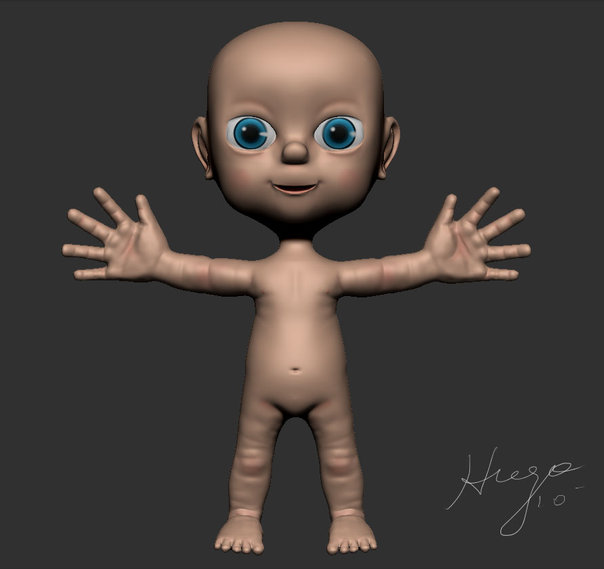
Toon Character Design - Baby Bender
still under working


this is another practice from zbrush to low poly model
this is the start from ZSphere


July 02, 2010
Toon Character Design - Bachi NO. 1
Still in working
Finally, normal mapping and texture mapping render in Maya real-time


I re-topology the head mesh in ZBrush and export the low poly model into Maya to add teeth hair and eyeball


Finally, normal mapping and texture mapping render in Maya real-time
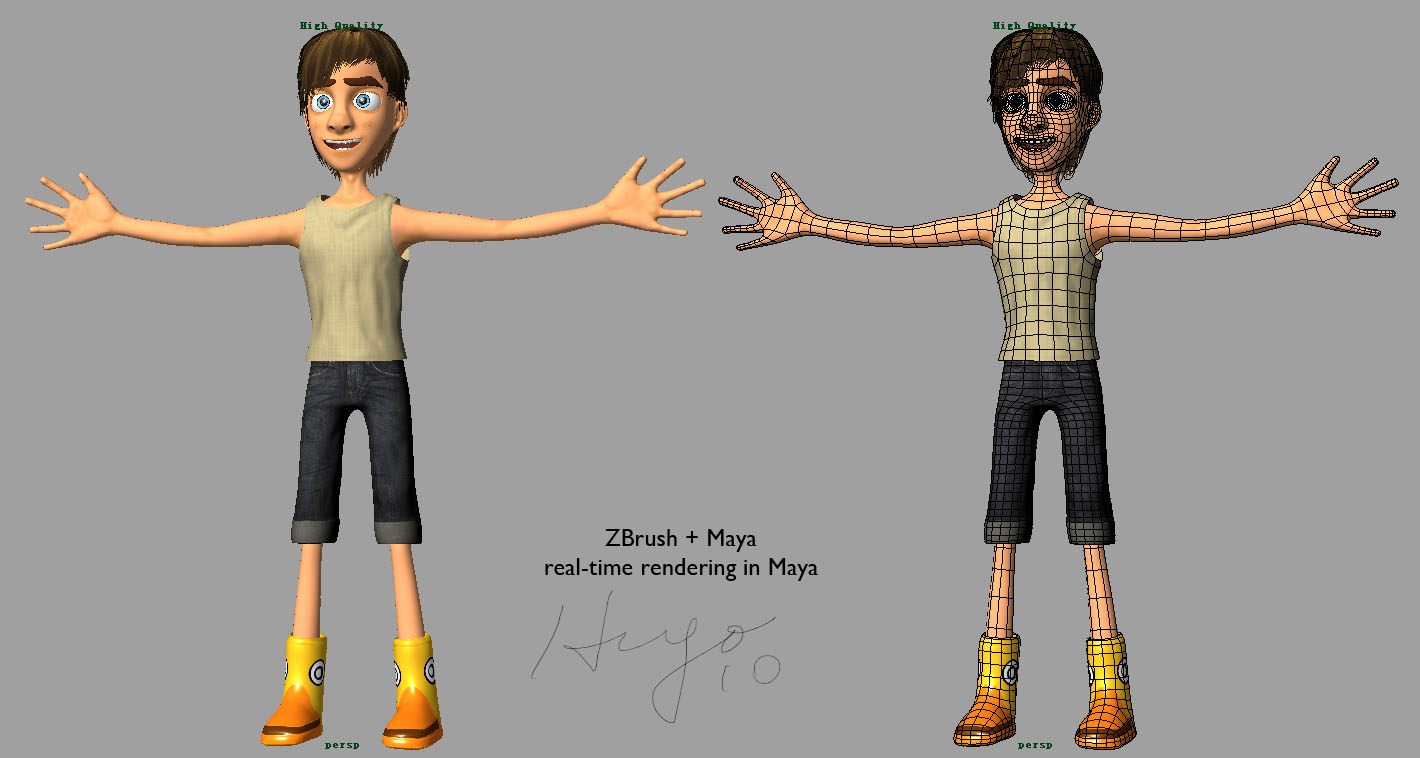

I re-topology the head mesh in ZBrush and export the low poly model into Maya to add teeth hair and eyeball
Render in Maya with AO

Topology

Zbrush Model

Bachi is a skinning, optimistic and brave boy.
June 20, 2010
ZBrush Male Practice (keep working)

Roughly finished a male body
keep working on hands, feet and the head
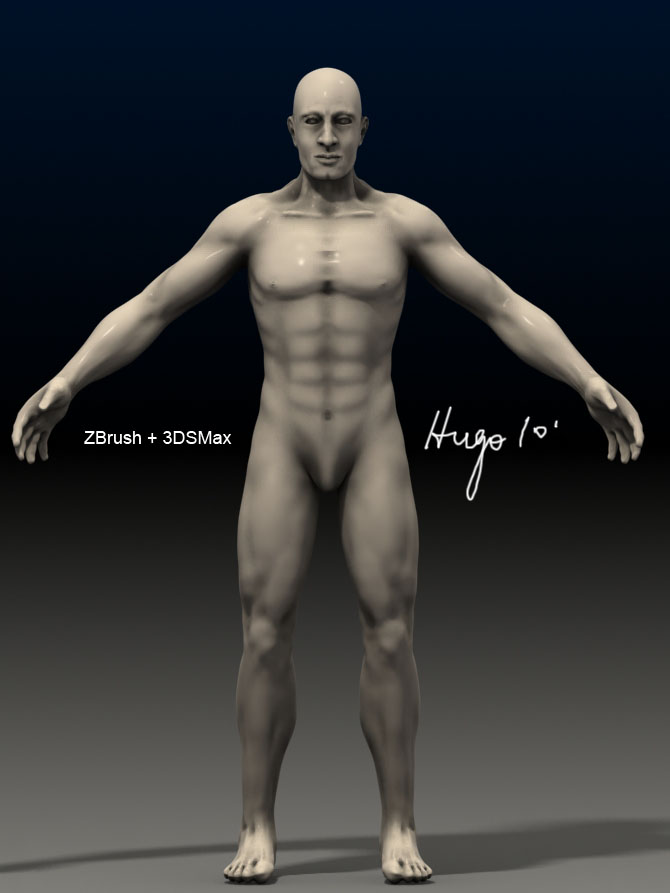
Head, hands and feet were finished (maybe)

June 14, 2010
ZBrush Cartoon Character Creation


Inspiration is from Gromit and Knee-hi from Free Philly


However, my client wants hairy dog, which is hard to make from 3D into 2D, sign......


However, my client wants hairy dog, which is hard to make from 3D into 2D, sign......
June 04, 2010
ZBrush Normal Map making

Actually it was started from zshpere, but I adjust meshes in 3DSMAX.
It's a simple practice, and I did some mistakes while dividing meshes
So, I re-unwrap the UV after carving.

Carved enough for normal map

Using normal map tool in ZBrush to export Normal Map
Note: when it was exported, Y axis would be flipped

test the normal map in Unity

June 03, 2010
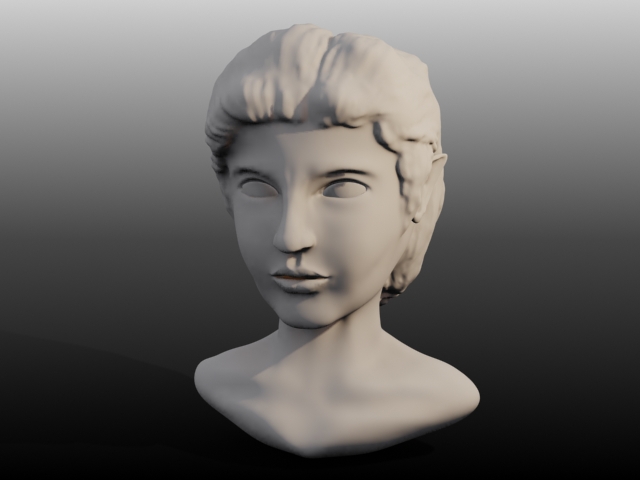


May 11, 2010
Concept Art for Game Design Class

The art combine two real photos and hand drawing to finish.

I intend to create a cute little girl to earn sympathy from players.
March 31, 2010
March 16, 2010
First sample of Windows Mobile Phone 7
For the project rendering test, I have to test the newest XNA 4.0
which just has been released on March 15th 2010.
Let's see

In fact, XNA 4.0 is very easy to use.
However there are several different things from XNA 3.1.
For my situation, there is no more Renderstate class. So if you want to change
any renderstate in the phone, you have to create separate state instance to change that.
like:
DepthStencilState dp = new DepthStencilState();
dp.DepthBufferEnable = true;
dp.DepthBufferWriteEnable = true;
effect.GraphicsDevice.DepthStencilState = dp;
another important thing is: phone is not allowed custom shader
In this rendering testing, I used AlphaTestEffect (drawing city), and Basiceffect (drawing City)
Basically, for a phone, it is very easy to implement 3D environment.
which just has been released on March 15th 2010.
Let's see

In fact, XNA 4.0 is very easy to use.
However there are several different things from XNA 3.1.
For my situation, there is no more Renderstate class. So if you want to change
any renderstate in the phone, you have to create separate state instance to change that.
like:
DepthStencilState dp = new DepthStencilState();
dp.DepthBufferEnable = true;
dp.DepthBufferWriteEnable = true;
effect.GraphicsDevice.DepthStencilState = dp;
another important thing is: phone is not allowed custom shader
In this rendering testing, I used AlphaTestEffect (drawing city), and Basiceffect (drawing City)
Basically, for a phone, it is very easy to implement 3D environment.
March 09, 2010
Velvet shader implemented in XNA
Basically,
cause I'm doing a project about XBOX avatar,
I try to use the shader that MS used in avatars.
I guess that shader is based on velvet.
So, I mixed the velvet, distant lighting and skinned model shader together to animate my looney dog in XNA.

The pity is my velvet shader is based on vertex shading
I'll try to do in pixel shading next time.
cause I'm doing a project about XBOX avatar,
I try to use the shader that MS used in avatars.
I guess that shader is based on velvet.
So, I mixed the velvet, distant lighting and skinned model shader together to animate my looney dog in XNA.

The pity is my velvet shader is based on vertex shading
I'll try to do in pixel shading next time.
January 28, 2010
NPR shading implementation (color distortion + cel shading)

NPR shading
Tool: ATI Rendermonkey
Language: HLSL
Concept:
These technique takes me 5 passes to finish it. And some passes need to be improved.
Pass 0: Cel shading
Pass 1: Color distortion
Pass 2: Normal
Pass 3: image based ink shading
Pass 4: Combination (Final)
As you can see, the technique includes three common shading, Cel, Color Distortion, and normal based ink.
The feature is the color distortion:

The idea of this shading is simple:
first the color has to be changed from RGB to HSV.
Then, sample one pixels from two special texture, and compare their value.
If their differential is bigger than X, the S and V of HSV value of the mapping pixel on rendertagart should be the average of the two sampling pixels.
However, my way to transform the color space has some problems
these step still needs to be improved
January 26, 2010
Tone Shader

Tool: ATI Rendermonkey
Language: HLSL
Concept:
Basically, this technique can be done by two pass. First, I create a basic infinite light shading to render to texture. The rendertarget uses the alpha to store the shading result. In the final pass, I use a 2D texture which is my "tone" map to lerp the last pass result. Done!
Key Code:
pass0:
float4 ps_main(float3 pos : TEXCOORD1, float3 nrm : TEXCOORD2) : COLOR
{
float diffuse = min(1.0,max(0,dot(-Light_Direction,nrm)));
diffuse = pow(diffuse,5);
diffuse = (diffuse*4)/3.0;
float4 Col = float4(1,1,1,diffuse);
return Col;
}
float4 ps_main(float2 tex: TEXCOORD0) : COLOR0
{
float4 color;
float4 base = tex2D(Texture0,tex);
float4 hatch = tex2D(Texture1, tex);
color = lerp(hatch , base, base.a) ;
return color * base;
}
Subscribe to:
Posts (Atom)


